
Strategic analysis of LLM nudges’ impact on consumer behavior

Strategic analysis of LLM nudges’ impact on consumer behavior

4 minutes

Table of contents

The paradigm of passive information retrieval has been superseded by a model of active action stimulation through so-called “LLM nudges.” These instruments function as a hidden catalyst, defining the trajectory of the customer journey and transforming a single query into a continuous cycle of interaction.

Differentiation of Nudge Formation Across Leading Platforms

The results demonstrate a clear pattern: the priority vector for dialogue development in most systems is the financial aspect. Economic expediency and the search for advantageous offers form the foundation of algorithmic recommendations.

  • Approximately 45% of all generated nudges directly relate to pricing issues and the search for favorable deals. Platforms such as Perplexity and ChatGPT show the highest correlation with this indicator, with the share of budget mentions exceeding 60%. In contrast, Meta’s model adopts a more restrained approach, minimizing automatic assumptions regarding the priority of low cost for the user.
  • The second most significant type of recommendation is product comparison suggestions. This mechanism covers a wide range of industries—from financial services and medical protocols to retail consumer goods. By providing the opportunity for instantaneous characterization comparisons, LLMs effectively assume the role of an expert consultant, which critically influences the final purchasing decision.
  • Contrary to the popular belief regarding the need to focus on detailed technical characteristics, the share of such queries in the structure of automated nudges remains insignificant. This indicates that while the availability of structured data is important for a brand’s ranking within the system, direct user engagement in further dialogue occurs through simpler and more emotionally resonant triggers (price, benefit, comparison).

Recommendations for Brands in an AI-Oriented Market

Given the aforementioned trends, business entities must revise their product positioning strategies in the digital environment:

  • Premium brands must account for the risk that an LLM may initiate a comparison of their products with budget alternatives. Understanding the algorithmic logic allows for the timely adaptation of content strategies to protect the value proposition.
  • Since comparison is a key stage of interaction, companies should ensure the availability of clear, verified data that allows AI models to correctly reflect the product’s competitive advantages.
  • Marketing strategies must account for the “incompleteness effect” of LLM dialogues. It is necessary to prepare content that not only answers the initial query but also fits organically into the likely next steps suggested by the artificial intelligence.

In conclusion, controlling the customer journey in 2026 requires not only a presence in AI output results but also a profound understanding of the mechanisms that prompt the user toward the next step. The professional management of these “hidden forces” is becoming a critical factor for success in the modern digital ecosystem.

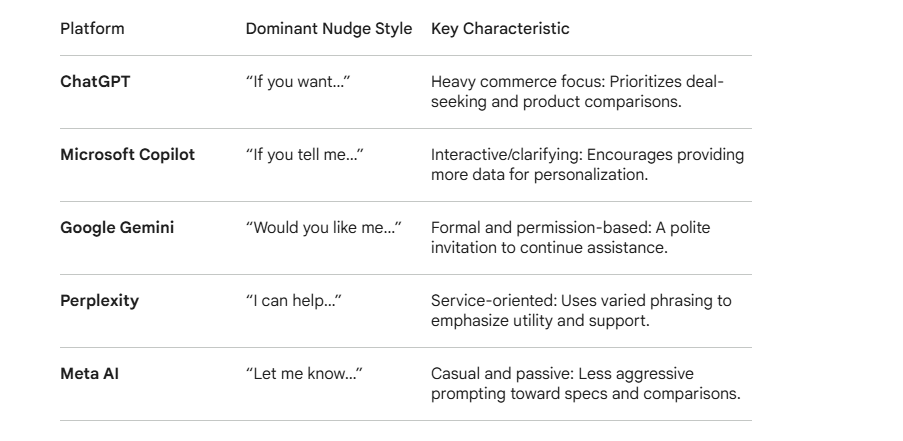
Comparative Analysis of Platform Stylistic Models

Research has shown that each Large Language Model (LLM) possesses a unique “communication personality” that defines its method of interacting with the user. The format of these nudges correlates directly with the operational goals of the respective technology giants.
Action Protocol for Businesses Based on AI Nudge Analysis

The primary objective of these nudges is to retain the user within the ecosystem and guide them through the sales funnel. Despite the limited data regarding the connectivity of individual dialogues, three strategic directions for content optimization can already be identified:

Capitalizing on the Technical and Post-Purchase Support Gap

Analysis indicates an existing deficit in proactive nudges within the sphere of technical problem-solving compared to commerce-driven queries.

  • Recommendation: Companies should invest in the creation of detailed instructions (how-to guides) and technical operation manuals. This will allow brands to establish authority in segments where AI currently demonstrates the least activity.

Prioritizing Comparative Content

As LLMs systematically prompt users toward comparative analysis, the absence of a brand from such comparisons represents a critical risk.

  • Recommendation: It is essential to scale the production of guides in a “Product A vs. Product B” format. This enables the integration of brand advantages directly into the logical chain formulated by the artificial intelligence.

Maximizing Presence in the Budget Solutions Segment

Pricing offers and discount programs serve as the primary trigger for nudges (48% of the total volume).

  • Recommendation: Ensuring AI access to structured, real-time data regarding current promotions and pricing is a mandatory requirement for securing referral traffic from commercial queries.

The LLM landscape continues to transform rapidly, becoming the primary interface for consumer decision-making. The priority task for organizations today is to transition from passive observation to active reputation management within the AI environment. Understanding the patterns through which Gemini, ChatGPT, or Perplexity reframe your brand’s value in the context of price or competition is the key to maintaining market positions in 2026.

This article is available in Ukrainian.

Digital marketing puzzles making your head spin?


Say hello to us!
A leading global agency in Clutch's top-15, we've been mastering the digital space since 2004. With 9000+ projects delivered in 65 countries, our expertise is unparalleled.
Let's conquer challenges together!


Hot articles

How to bridge the gap between positioning and search intent

How to bridge the gap between positioning and search intent

Google: AI drives up to 80% sales growth for leading brands

Google: AI drives up to 80% sales growth for leading brands

Google Introduces Sponsored Ads in Mobile “Images” Tab

Google Introduces Sponsored Ads in Mobile “Images” Tab

Read more

LLM perception match: a new barrier to visibility in the age of AI

LLM perception match: a new barrier to visibility in the age of AI

performance_marketing_engineers/

performance_marketing_engineers/

performance_marketing_engineers/

performance_marketing_engineers/

performance_marketing_engineers/

performance_marketing_engineers/

performance_marketing_engineers/

performance_marketing_engineers/