
7 ways Google Ads can influence marketers’ decisions

Google Ads promotional credits disappear after advertisers meet promotional requirements

Amazon Tests Advertising on ChatGPT Through Amazon DSP

In the SEO world, the name “Googlebot” is often used as a catch-all term. However, from a technical standpoint, it represents a massive ecosystem that balances the speed of the internet with the immense computational costs of data processing. Let’s dive deep into the mechanics of Google’s crawling infrastructure and why your page size matters more than you think.
Googlebot is not a standalone crawler; it is part of a centralized crawling platform. This means there is a single unified “engine” that manages request queues, IP address distribution, and crawl demand.
robots.txt file (e.g., allowing Search but blocking Image Search).Most web pages weigh between 100–500 KB, making the 2MB limit seem safe. However, certain “traps” can lead to Googlebot seeing only a fraction of your site:
</html> tag or essential internal links are located after the 2MB threshold, Googlebot will ignore them. To the crawler, the page effectively ends at the last byte of the limit.Fetching is just the retrieval of “raw” text. To understand modern websites built with React, Vue, or Angular, Google triggers a rendering process.
One of the most critical technical aspects is that Googlebot arrives at a page as a “brand new user” every time:
Pro Tip: If your content (such as price or product descriptions) depends on a selection a user made on a previous page, Googlebot will likely only see the default state.
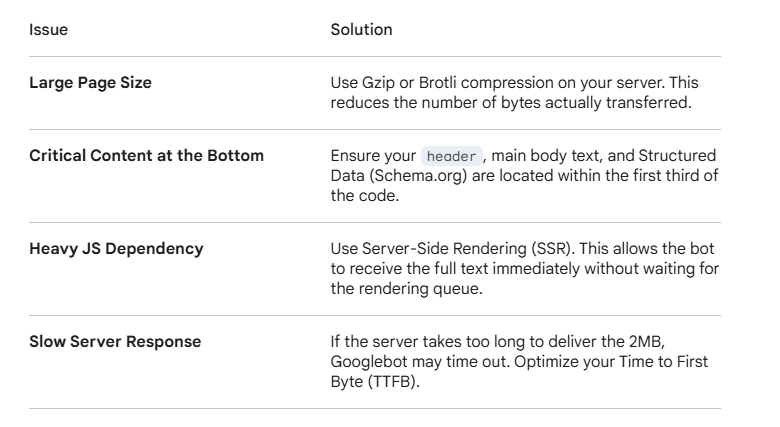
Understanding that Googlebot has data limits changes the approach to web development. A webpage is not just a visual object; it is a data stream. The faster and more compactly you deliver the most important information within those first 2 megabytes, the higher your chances of successful indexing and ranking in 2026.
Read this article in Ukrainian.
Say hello to us!
A leading global agency in Clutch's top-15, we've been mastering the digital space since 2004. With 9000+ projects delivered in 65 countries, our expertise is unparalleled.
Let's conquer challenges together!
performance_marketing_engineers/
performance_marketing_engineers/
performance_marketing_engineers/
performance_marketing_engineers/
performance_marketing_engineers/
performance_marketing_engineers/
performance_marketing_engineers/
performance_marketing_engineers/