
Google Expands Conversion Lift to Search and Performance Max Campaigns

Google Display Migration to Demand Gen: How to Protect Your Advertising Budget
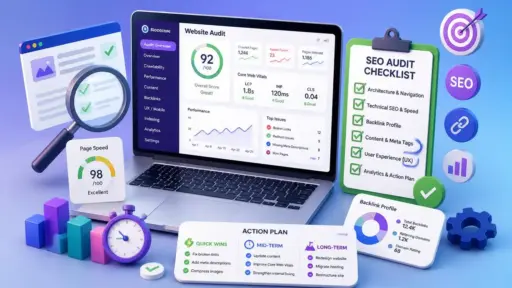
How to conduct a website audit in 6 steps

The modern digital marketing ecosystem is undergoing a fundamental transformation, driven by the integration of Artificial Intelligence into search, data aggregation, and retrieval processes. The latest update to Google Lighthouse introduces an experimental audit category named “Agentic Browsing”. A key component of this update is a deterministic check verifying whether websites host an llms.txt file in their root directory.
This development introduces a strategic paradox for businesses. Official representatives from Google Search previously stated that such files are non-essential for organic search visibility, while Chrome developers have now integrated them into technical checklists. This article provides a comprehensive analysis of the new audit architecture, distinguishes between traditional SEO and AI Agent Optimization (AEO), and outlines actionable recommendations for medium and large enterprises.
Unlike traditional Lighthouse metrics that evaluate a web resource’s performance for human users (e.g., loading speed, interactivity, visual stability via Core Web Vitals), the Agentic Browsing category gauges how effectively a website interacts with autonomous machines, such as AI agents, web scrapers, and Large Language Models (LLMs).
The new audit diverges from the standard 0–100 scoring system. Instead, it displays a fractional pass ratio based on deterministic validation checks designed to assess AI agent readiness.
Key Technical Parameters Validated by the New Lighthouse Audit:
The roll-out of this audit follows closely on the heels of Google’s newly published guide, “Mythbusting Generative AI Search.” In it, the company explicitly noted that creating llms.txt files, custom AI text directives, or Markdown alternatives is not a requirement for a site to appear in AI Overviews or AI Mode within standard Google Search.
To resolve this ambiguity, John Mueller, Search Advocate at Google, provided an extensive explanation regarding the functional separation of web assets:
“It is critical to separate ‘discovery’ (finding a website or pages via a global search engine for SEO) from ‘functionality’ (helping a user or agent complete a specific task once they land on the page). The inclusion of llms.txt files is not an SEO initiative. AI agents with constrained context windows often struggle with or truncate excessively long HTML pages. Serving a lightweight Markdown alternative or a structured summary is a tool for interaction efficiency and token-saving, not an organic ranking factor in Google Search.”
He also added that for standard commercial sites (e.g., an online shoe retailer), creating Markdown versions of technical specs does not yield immediate business value, unlike developer platforms or technical documentation hubs where AI-assisted coding is dominant.
According to Google Chrome documentation, autonomous AI agents interpret web pages differently than traditional web crawlers. Their primary data model relies on the Accessibility Tree. If interactive components lack programmatic labels or are hidden from assistive frameworks, an AI agent will fail to execute conversion actions, such as form submissions or checkouts on behalf of the user.
Furthermore, Addy Osmani, Director of Engineering for Cloud AI at Google, introduced the concept of AEO (Agentic Engine Optimization). He highlighted the following requirements for next-generation web architectures:
AGENTS.md).Faced with these technical updates, CMOs and digital leaders must prioritize technical implementation pipelines based on business vertical alignment rather than speculative trends.
| Business Vertical / Asset Type | llms.txt Necessity | Strategic Action Item |
| B2B, SaaS, Tech Platforms, Enterprise Documentation | HIGH PRIORITY | Deploy llms.txt to the root directory. Provide clean Markdown mirrors of reference manuals to streamline execution for developers leveraging AI coding tools (e.g., GitHub Copilot, Gemini). |
| E-commerce (Enterprise Retail, Marketplaces) | LOW / MONITOR | Generating Markdown alternatives for standard product sheets yields negligible commercial return. Maintain engineering focus on standard structured data (Schema.org, Merchant Center feeds). |
| Content Publishers, Media Hubs, Professional Services | LOW PRIORITY | Maintain rigorous emphasis on content depth and traditional EEAT frameworks. Advanced machine agents possess the native capability to parse clean HTML. |
The implementation of llms.txt checks and Agentic Browsing metrics within Google Lighthouse serves as an explicit indicator that Google is optimizing browser ecosystems for autonomous machine interaction. However, as of 2026, these parameters do not influence organic search positioning within Google Search algorithms.
For market leaders and enterprise entities, the immediate operational mandates remain flawless technical SEO execution, optimized user experiences (UX), and high-value content strategy (Helpful Content guidelines). Adopting AI-specific index files should be treated as an isolated innovation vector for technical verticals where automated machine interaction directly correlates with developer ecosystem loyalty and B2B engagement.
Read this article in Ukrainian.
.
Say hello to us!
A leading global agency in Clutch's top-15, we've been mastering the digital space since 2004. With 9000+ projects delivered in 65 countries, our expertise is unparalleled.
Let's conquer challenges together!
performance_marketing_engineers/
performance_marketing_engineers/
performance_marketing_engineers/
performance_marketing_engineers/
performance_marketing_engineers/
performance_marketing_engineers/
performance_marketing_engineers/
performance_marketing_engineers/