
7 ways Google Ads can influence marketers’ decisions
Google Ads promotional credits disappear after advertisers meet promotional requirements

Amazon Tests Advertising on ChatGPT Through Amazon DSP
Google has quietly rolled out a substantial update to Brand Lift: two “NEW” labels have appeared in the study settings—Enhanced Lift as a Study Strength option and the Association metric. There was no loud announcement, just new features in the interface. However, behind each of them lies a very specific problem that Google has finally addressed.
At UAMASTER, we regularly run Brand Lift studies for clients across various categories—from FMCG to finance and telecom. These updates are far from abstract for us; below, we break down what has changed and how it impacts practical application.
The majority of ad campaigns conducted using Brand Lift have shown clear results—an increase in metrics. However, in some previous cases, there was a real issue: the effect existed, but it was too small for the system to provide a confident result based on a standard volume of responses. For example, when the baseline Brand Awareness was already very high, as is often the case with mobile operators.
Google describes Enhanced Lift as a higher-sensitivity measurement option that collects significantly more survey responses than Standard Lift. Formally, this entails three things:
In practical terms, if you previously needed to spend $5,000 on YouTube ads for one question in Ukraine, be prepared to allocate $15,000 for Enhanced Lift.
The practical sense is very grounded. In brand advertising, not every effect looks like +5% or +7%. Especially for major brands, in mature categories, or in campaigns with a narrow audience, the lift may be smaller but still economically significant. The problem is that the smaller the absolute lift, the more responses are needed for the system to statistically record it.
For an advertiser, this has direct management value. When Standard Lift fails to provide a conclusion, businesses often make the false assumption: “Upper funnel isn’t working.” But the reality may be different: “With the current study design, we were unable to reliably capture the effect.” Enhanced Lift reduces this specific risk. For brands with large media investments, this means fewer chances of discarding valuable creative learnings simply because the study wasn’t sensitive enough.
When Enhanced Lift is Truly Appropriate:
Expert Opinion from UAMASTER
Vadym Lytvynenko, Head of PPC at UAMASTER: “Enhanced Lift is primarily about not losing insights due to methodological limitations. We see how clients with large brand budgets sometimes get ‘Not enough data’ and immediately conclude that the campaign failed. In reality, the problem is often in the study design, not the ads. Enhanced Lift is the right tool to verify this, rather than guessing.”
It is important to remember: Enhanced Lift increases the chances of detecting a lift but does not guarantee a positive result. Furthermore, if the budget is reduced below the eligibility threshold during the study, it may stop without collecting enough data. Therefore, such measurements should only be launched once the media plan and budget discipline are fully agreed upon.
The second change is strategically even more interesting. Association measures whether the audience links the brand with specific attributes: qualities, values, usage situations, or key campaign messages. The survey question is structured as: “Which of these brands do you associate with [attribute]?”
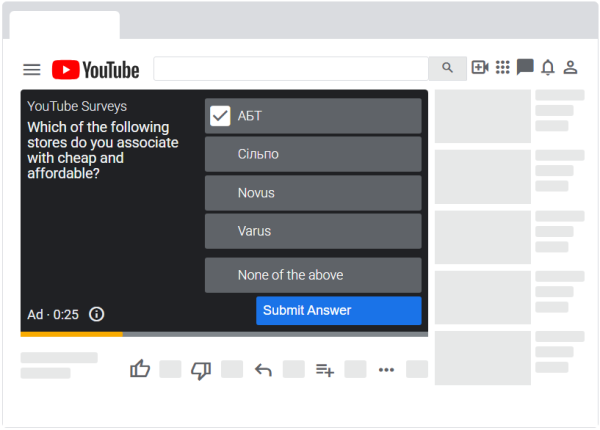
Ось переклад фінальної частини тексту на англійську мову:
NB! This feature has just been launched, so the translation for the Association question into Ukrainian is not yet available. We expect it to appear soon. Other questions, of course, have long been available in Ukrainian.
Because an ad can perform exceptionally well for Ad Recall while simultaneously underperforming on strategic substance. People might remember the video, recognize the brand, and even show an increase in Awareness—yet still fail to link the brand with the specific benefit or role you were trying to establish. For a brand launching a new product line, re-entering a category, shifting its positioning, or defending its premium status, this question is central. It’s not about “did they see it,” but “what exactly did they associate with the brand after the contact.”
Effectively, Google has provided marketers with a tool that aligns with the actual logic of brand strategy. If a campaign is intended not just to remind people of the brand’s existence but to anchor a new associative territory, an Awareness metric alone is no longer sufficient.
Together, these two updates change the approach to setting up Brand Lift. Previously, the choice of metrics often boiled down to “let’s set Ad Recall + Awareness to show a baseline effect.” Now, there is a tool to more accurately reflect real marketing objectives.
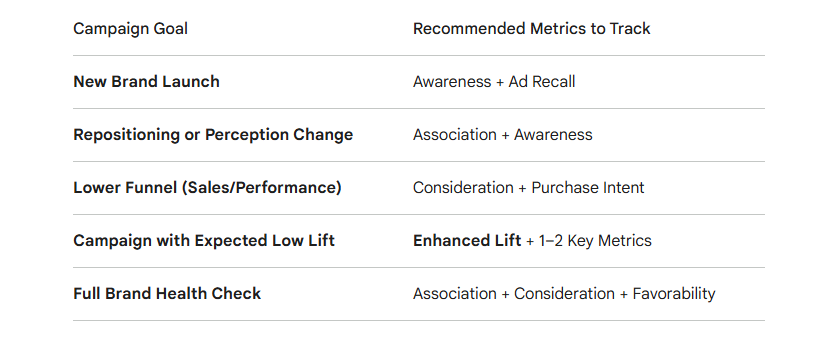
Google allows you to select up to three metrics. However, the real power lies not in the maximum quantity, but in the right combination tailored to a specific business objective:
Google explicitly states that for accurate Brand Lift measurement in Demand Gen campaigns, video placements on YouTube should be prioritized. This is because other Demand Gen surfaces—Gmail and Discover—are not included in this specific measurement. This is a crucial detail for the correct interpretation of results that is easily overlooked.
Within a single budget, you can run both Brand Lift + Search Lift simultaneously.
Enhanced Lift increases measurement reliability in cases where an effect exists but is statistically difficult to “capture.” Association adds what has long been missing from many brand evaluations: the ability to verify if the advertising creates the exact brand connection intended by the strategy.
In essence, Brand Lift has moved closer to the actual needs of large and mature advertisers. It’s no longer just about measuring whether the ads “did something.” It’s about measuring whether they achieved exactly what they were launched for.
If you would like to discuss how to build a measurement strategy for your brand campaigns, the UAMASTER team is ready to help.
Read this article in Ukrainian.
Say hello to us!
A leading global agency in Clutch's top-15, we've been mastering the digital space since 2004. With 9000+ projects delivered in 65 countries, our expertise is unparalleled.
Let's conquer challenges together!
performance_marketing_engineers/
performance_marketing_engineers/
performance_marketing_engineers/
performance_marketing_engineers/
performance_marketing_engineers/
performance_marketing_engineers/
performance_marketing_engineers/
performance_marketing_engineers/