
Google Demand Gen Without Wasting Budget

How to Make Your Business the Obvious Choice in Google Ask Maps

What Meta’s New Advertising Formats Mean for Your Business

A new player has entered the world of SEO — LLMS.txt. Unlike the familiar robots.txt, this isn’t a file of restrictions. Instead, it’s a compass that points large language models (LLMs) to the most valuable content on your website.
To understand what LLMS.txt really is, let’s compare it to other well-known SEO files:
| File Type | Function | Purpose |
|---|---|---|
robots.txt | Controls crawler access | Manages indexing |
sitemap.xml | Lists available pages | Prioritizes crawling |
llms.txt | Points to LLM-friendly content | Guides AI during content queries |
Despite its name, LLMS.txt is not an extension of robots.txt. It doesn’t block crawling, prohibit indexing, or restrict access. Instead, it’s a menu for AI, highlighting which pages contain the most valuable, clear, and trustworthy information.
This file is designed to help AI:
It’s not training data — LLMS.txt doesn’t teach the model, but it helps the model find and understand key content during response generation.
Models like ChatGPT or Google AI Overviews don’t just index your content. They may use it in real-time to generate responses. But they don’t always land on your homepage — often, they enter through deeply buried links.
If your site has:
…AI might simply miss your best information. LLMS.txt allows you to spotlight your most important pages right away.
For AI to easily digest your content, it should be:
The easier it is for the model to extract and understand a snippet, the more likely it is to cite you.
The LLMS.txt file is placed in your website’s root directory:https://example.com/llms.txt
The format is simple Markdown:
# One top-level heading for your project name> A short quote block with description or goal## One or more subheadings with link categories[Title](URL): short descriptionImportant: The file must be named LLMS.txt — with an “S” — or it won’t be recognized.
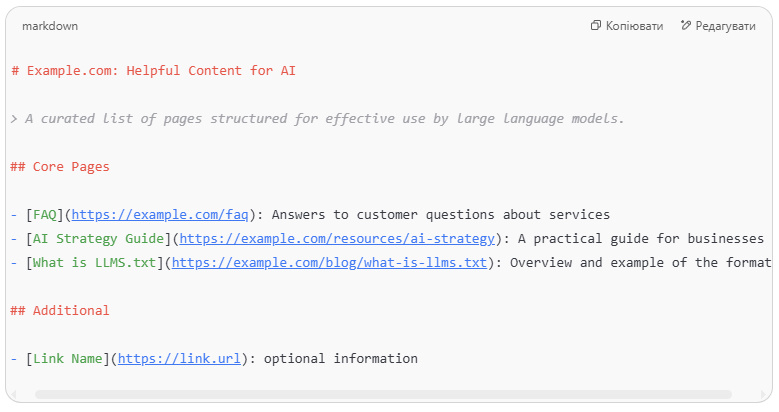
The ## Additional category is optional. It contains less critical pages that models may skip when token limits are tight.
Not always. The homepage is often a branding “showroom” rather than a deep source of structured information.
Instead, it’s more effective to highlight:
Exception: If your homepage is a true content hub, well-structured and useful, it’s worth including.
According to Mintlify, early adopters include OpenAI, Anthropic, Perplexity, and other major players. The standard is still evolving, but early implementation gives you an edge.
While it doesn’t guarantee citation, LLMS.txt improves your chances by showing AI exactly where to find high-quality content.
LLMS.txt is not about control — it’s about navigation. It’s not for Googlebot — it’s for GPT.
In a future where answers are created in real time, you must pre-prepare the content you want included in those answers.
The homepage isn’t always the most valuable source for SEO or AI-driven analytics — it often serves a branding purpose. Unless it functions as a structured hub of high-quality content, it’s better to prioritize deeper internal pages: service descriptions, blog posts, guides, and analytical resources that offer real informational value.
This article available in Ukrainian.
Say hello to us!
A leading global agency in Clutch's top-15, we've been mastering the digital space since 2004. With 9000+ projects delivered in 65 countries, our expertise is unparalleled.
Let's conquer challenges together!
performance_marketing_engineers/
performance_marketing_engineers/
performance_marketing_engineers/
performance_marketing_engineers/
performance_marketing_engineers/
performance_marketing_engineers/
performance_marketing_engineers/
performance_marketing_engineers/