Google Expands Conversion Lift to Search and Performance Max Campaigns

Google Display Migration to Demand Gen: How to Protect Your Advertising Budget

How to conduct a website audit in 6 steps

Today, platforms such as TripAdvisor, Google Business Profile, online travel agencies (OTAs), and user reviews serve as key data sources that AI systems use to evaluate travel brands. Let’s explore strategies for strengthening these signals and increasing your chances of being recommended by AI-powered platforms.
AI Overviews and Google AI Mode are currently among the most discussed topics within the SEO community. The dominant trend is clear: search engines are evolving from information retrieval tools into full-fledged recommendation engines.
For brands in the travel and hospitality industry, this fundamentally changes the rules of digital distribution. The challenge is no longer limited to optimizing a website for search crawlers. Instead, businesses must help AI systems understand under which circumstances their brand is the most relevant recommendation for a particular user.
A growing share of consumers actively interacts with large language models (LLMs) on a weekly basis. Modern AI tools allow users to organize conversations into projects, create dedicated folders for upcoming trips, and build contextual knowledge based on previous interactions that already reflect personal interests, travel preferences, and demographic characteristics.
This signals a shift away from traditional search behavior. Previously, travel planning typically began with isolated Google searches such as:
Today, the process has become conversational. Instead of entering disconnected keywords, travelers create a dedicated project—such as “Summer 2026″—within ChatGPT or another AI assistant and begin with a broad request that gradually evolves into a detailed itinerary.
Examples of modern travel queries include:
The interaction then develops into an ongoing dialogue covering restaurants, attractions, accommodations, transportation options, and daily itinerary planning. In this environment, consumers are no longer looking for lists of websites—they want expert recommendations.
AI Overviews aggregate information from multiple sources and provide users with structured, verified recommendations instead of traditional lists of links. As a result, visibility factors such as source credibility, data consistency, and contextual relevance become increasingly important.
A hotel or tourism business can influence a traveler’s decision directly through an AI-generated response, even without an immediate visit to its website. The next step often involves a branded search, checking review platforms, or booking through an OTA.
To maintain strong visibility in AI-generated results, brands need a clear and consistent digital identity. AI systems must understand what makes your business unique, who it serves, and why it is relevant.
Define a primary category and establish a clear market position. AI systems perform better when they can easily associate your brand with a specific travel need or audience segment.
Invest in external brand mentions and expert content. The goal is to ensure that your business is regularly featured in authoritative travel articles, destination guides, industry publications, and expert roundups.
Maintain accurate, up-to-date, and consistent business information across your website, Google Business Profile, TripAdvisor, OTA platforms, and official social media channels. Consistency across these sources strengthens trust signals and improves AI confidence in recommending your brand.
The evolution of search engines is reshaping how SEO performance should be measured. While traditional metrics remain important, travel marketers need to expand the way they evaluate brand visibility and digital performance.
A common misconception is that a decline in clicks caused by zero-click experiences automatically signals a loss of exposure. In reality, the customer journey is becoming more complex. A traveler may first discover a hotel or destination through an AI-generated response, later perform a branded search, visit a TripAdvisor profile, or complete a booking through a partner distribution channel.
For this reason, growth in branded search volume is becoming one of the most important indicators of visibility within AI-powered search environments. Marketing teams at mid-sized and enterprise travel businesses should consider incorporating metrics such as AI mentions, citations, and assisted conversions into their KPI frameworks.
Analytical note: Assisted conversions help identify all touchpoints that influenced a booking decision, even if they were not the final traffic source. In Google Analytics 4 (GA4), this data can be analyzed under Advertising > Attribution > Conversion Paths.
TripAdvisor and Online Travel Agencies (OTAs) have evolved far beyond review and booking platforms. Today, they serve as critical knowledge sources for large language models and AI-powered recommendation systems.
When generating recommendations, AI systems rarely rely on a single source of information. Instead, they cross-reference multiple data points, with a brand’s website representing only one element within a broader digital ecosystem. Algorithms continuously aggregate information from reviews, travel guides, media coverage, local directories, and other trusted sources. In practice, this makes online reputation management a key component of AI visibility.
This additional semantic context allows AI systems to determine whether a property is relevant to highly specific user needs, including:
To achieve strong visibility in generative search results, travel brands must communicate clear and consistent signals about their identity and target audience.
Focus content and customer reviews on family rooms, children’s facilities, swimming pools, entertainment programs, and family-oriented services.
Strengthen messaging around couples’ experiences, spa facilities, intimate atmospheres, honeymoon packages, and special occasion offerings.
Highlight conference facilities, coworking spaces, high-speed Wi-Fi, business services, and proximity to commercial districts.
Encourage reviews, media coverage, and expert recommendations that emphasize signature dishes, renowned chefs, unique dining concepts, or distinctive culinary experiences.
Many hospitality businesses naturally serve multiple audience segments. However, the more clearly defined and consistently communicated your primary positioning is, the easier it becomes for AI-powered search systems to understand your relevance for specific user queries and include your brand in recommendation results.
The same principle applies to destination marketing. Cities, regions, and tourism boards that consistently reinforce a distinct identity and value proposition are more likely to be surfaced by AI systems when travelers seek recommendations tailored to their interests and preferences.
As AI systems increasingly rely on entities rather than individual web pages to understand and recommend businesses, travel brands must focus on creating a clear, consistent, and trustworthy digital footprint.
Structured data helps search engines and AI systems accurately interpret key business information. For travel and hospitality brands, it is essential to provide structured information about accommodation types, amenities, location details, and available services.
Particular attention should be paid to differentiating attributes that set a property apart from competitors, such as:
The more clearly your information is structured, the easier it becomes for AI systems to understand your business and determine when it is relevant to a user’s specific travel needs.
Brands should conduct regular audits of their online presence to identify and eliminate conflicting information across external websites and platforms. Since generative search systems aggregate information from multiple sources, inconsistencies can reduce confidence in the accuracy of your business profile.
Common issues include:
AI systems often interpret these discrepancies as unreliable signals.
The most effective solution is to maintain complete consistency across all major digital touchpoints, including your website, Google Business Profile, TripAdvisor listings, and OTA profiles. A unified data ecosystem minimizes ambiguity and strengthens the confidence score AI systems assign to your brand.
One of the most valuable exercises for marketers is conducting a semantic analysis of customer reviews. This process helps identify:
Customer feedback often provides the clearest picture of a property’s genuine competitive advantages.
Specific operational details such as parking availability, accessibility features, opening hours, pet policies, and other factual information enable AI systems to answer highly specific user queries more accurately.
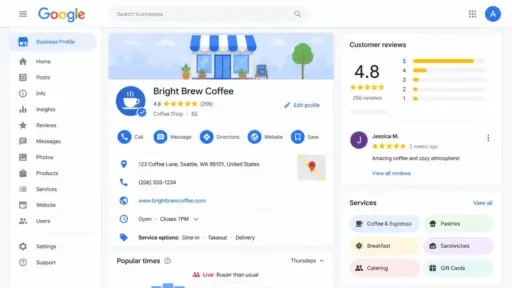
Google Business Profile serves as one of the primary repositories of this operational data. Business categories, profile attributes, and up-to-date opening hours directly influence how AI-powered search systems interpret and surface your business.
To further enrich this context, brands should regularly publish updates through Google Business Profile Posts and link them to relevant landing pages on their websites. This approach not only keeps business information current but also encourages customer engagement and strengthens local search visibility.
Generative search is proving to be more democratic than traditional search algorithms. AI models increasingly recommend actual businesses and real-world locations rather than simply surfacing well-optimized web pages. As a result, brand visibility is no longer determined solely by the quality of your website—it is shaped by your company’s entire digital footprint across the web.
For marketing teams in the travel and hospitality industry, this represents a fundamental shift. Success now requires moving beyond traditional SEO metrics such as rankings and click-through rates toward strategic management of the broader brand ecosystem.
Customer reviews, OTA profiles, mentions in authoritative travel guides and industry publications, as well as accurate and actively maintained business listings, have become critical data sources that AI systems use to understand your business and determine when it should be recommended to travelers.
Modern marketing environments require greater agility, continuous experimentation with emerging technologies, and the development of cross-marketing partnerships with complementary businesses. Hotels, restaurants, attractions, transportation providers, and destination marketing organizations all contribute to the broader ecosystem of trust signals that influence AI-generated recommendations.
Ultimately, the key strategic objective for mid-sized and enterprise travel brands is the systematic creation, management, and amplification of the digital signals that AI systems trust most. Businesses that successfully establish a consistent, credible, and well-documented presence across the digital landscape will be better positioned to earn visibility within AI-powered search experiences and recommendation engines.
As search continues its transition from information retrieval to recommendation-driven discovery, trust, consistency, and entity authority are becoming the new foundations of digital visibility.
Read this article in Ukrainian.
Say hello to us!
A leading global agency in Clutch's top-15, we've been mastering the digital space since 2004. With 9000+ projects delivered in 65 countries, our expertise is unparalleled.
Let's conquer challenges together!
performance_marketing_engineers/
performance_marketing_engineers/
performance_marketing_engineers/
performance_marketing_engineers/
performance_marketing_engineers/
performance_marketing_engineers/
performance_marketing_engineers/
performance_marketing_engineers/