How Online Reviews Influence Sales: Five Questions for CMOs

Google Unifies Google Tag and Tag Manager
Google AdMob introduces AI tools to automate monetization and ad management

Microsoft is introducing a “Made with AI” label for advertisements featuring visuals created using artificial intelligence. The new label will appear across Microsoft Advertising and Bing Search, helping users distinguish AI-generated content from traditional advertising images.
The update is part of Microsoft’s broader strategy to increase transparency around the use of artificial intelligence in digital advertising. Advertisers will now have tools to disclose the use of generative AI in visual assets and manage the corresponding labels directly within their campaigns.
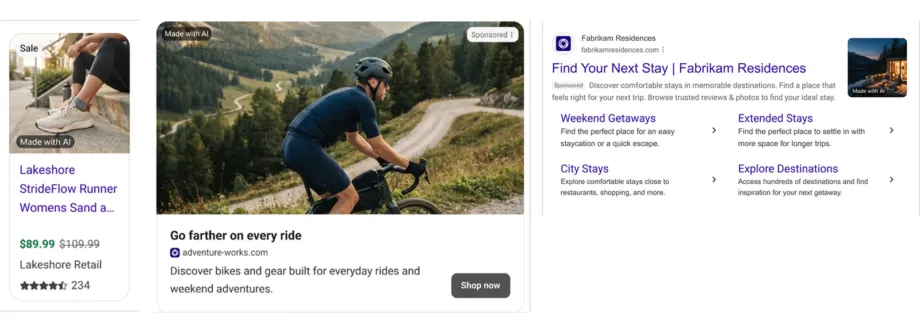
Microsoft announced the launch in its November 2026 product update. Its AI content transparency controls are now generally available in Microsoft Advertising.
The “Made with AI” label will appear in the corner of supported ad images, informing users that the visual content in an advertisement was created using artificial intelligence.
Advertisers will have several options:
With these features, Microsoft aims to make the use of AI in advertising more transparent for both audiences and advertisers.
Generative AI has already become part of everyday marketing workflows. Teams use it to create advertising banners, product images, videos, illustrations, and other creative assets.
This makes it possible to produce advertising materials faster, test different visual concepts, and adapt creatives for different audiences. However, the growing volume of AI-generated content raises a new question: should users know when an image they see in an advertisement has been generated by AI?
This is particularly relevant to product and service advertising, where visual accuracy can directly influence purchasing decisions. For example, an AI-generated product image may differ from the actual item. Similarly, generated scenes or characters can create the impression that certain events or situations are real.
The “Made with AI” label is intended to reduce this uncertainty. It does not prohibit the use of generative AI but helps audiences better understand the origin of advertising content.
For brands, this is also a matter of trust. As AI-generated materials become increasingly common, transparency about their use can become an important part of communication with potential customers.
Despite introducing these new tools, Microsoft’s system has limitations. Its AI detection signals are advisory rather than definitive and do not conclusively establish whether an image or video was created using artificial intelligence.
This means advertisers cannot rely entirely on the platform’s automated checks. They remain responsible for determining whether their materials contain AI-generated elements and ensuring that the relevant information is declared accurately.
This is particularly important for companies that use AI tools to produce large volumes of advertising creatives. When multiple teams, external contractors, and generative services are involved in campaign production, businesses will need to establish processes for tracking the origin of their assets.
Otherwise, even with the new tools available, some AI-generated content may remain improperly labeled.
The introduction of “Made with AI” is another indication that the use of generative artificial intelligence is gradually becoming a separate aspect of advertising campaign management.
Previously, the main focus was on creative quality, brand consistency, and campaign performance. Now, advertisers must also pay attention to the origin of their content.
For marketing teams, this means several practical changes.
Companies should understand which images and videos are entirely AI-generated, which contain only certain AI-generated elements, and which are produced using traditional methods. This is particularly important when multiple teams or external contractors are involved in creative production.
AI disclosure is becoming part of the advertising experience. Marketers should therefore evaluate not only the creative itself but also how audiences may perceive it alongside the corresponding label.
Using AI-generated creatives does not necessarily have a negative impact on how consumers perceive a brand. However, presenting AI-generated content as real photographs or events can create reputational risks. Clear labeling can help prevent some of these misunderstandings.
Microsoft is not the only company developing mechanisms to improve AI content transparency. Similar approaches are gradually emerging across digital ecosystems, making it important for advertisers to consider the requirements of every platform on which they run campaigns.
The introduction of “Made with AI” in Microsoft Advertising could become part of a broader trend toward labeling content created using generative artificial intelligence.
As AI tools evolve, distinguishing real images from AI-generated ones is becoming increasingly difficult. This creates a need for clear mechanisms to inform audiences, particularly in advertising, where the authenticity of visual materials can directly influence purchasing decisions.
However, the effectiveness of this initiative will depend on two factors: how responsibly advertisers disclose their use of AI and how consistently Microsoft applies the labels across its advertising formats.
For businesses, the key takeaway is that the use of artificial intelligence in advertising is gradually moving beyond production efficiency and into the realm of transparency and consumer responsibility. Marketers will need to consider this alongside creative quality, campaign optimization, and overall advertising performance.
Say hello to us!
A leading global agency in Clutch's top-15, we've been mastering the digital space since 2004. With 9000+ projects delivered in 65 countries, our expertise is unparalleled.
Let's conquer challenges together!
performance_marketing_engineers/
performance_marketing_engineers/
performance_marketing_engineers/
performance_marketing_engineers/
performance_marketing_engineers/
performance_marketing_engineers/
performance_marketing_engineers/
performance_marketing_engineers/